
Multiplication Facts “War” Card Game
Multiplication “War” is hands down one of my favorite ways to practice times tables. Why? Because the second I say “card game,” my kids come running. Add the chance to beat a sibling, and suddenly everyone is a math fan.
If you grew up playing “War” with a regular deck of cards, you already know how this works. Each player flips a card, and the bigger card wins.
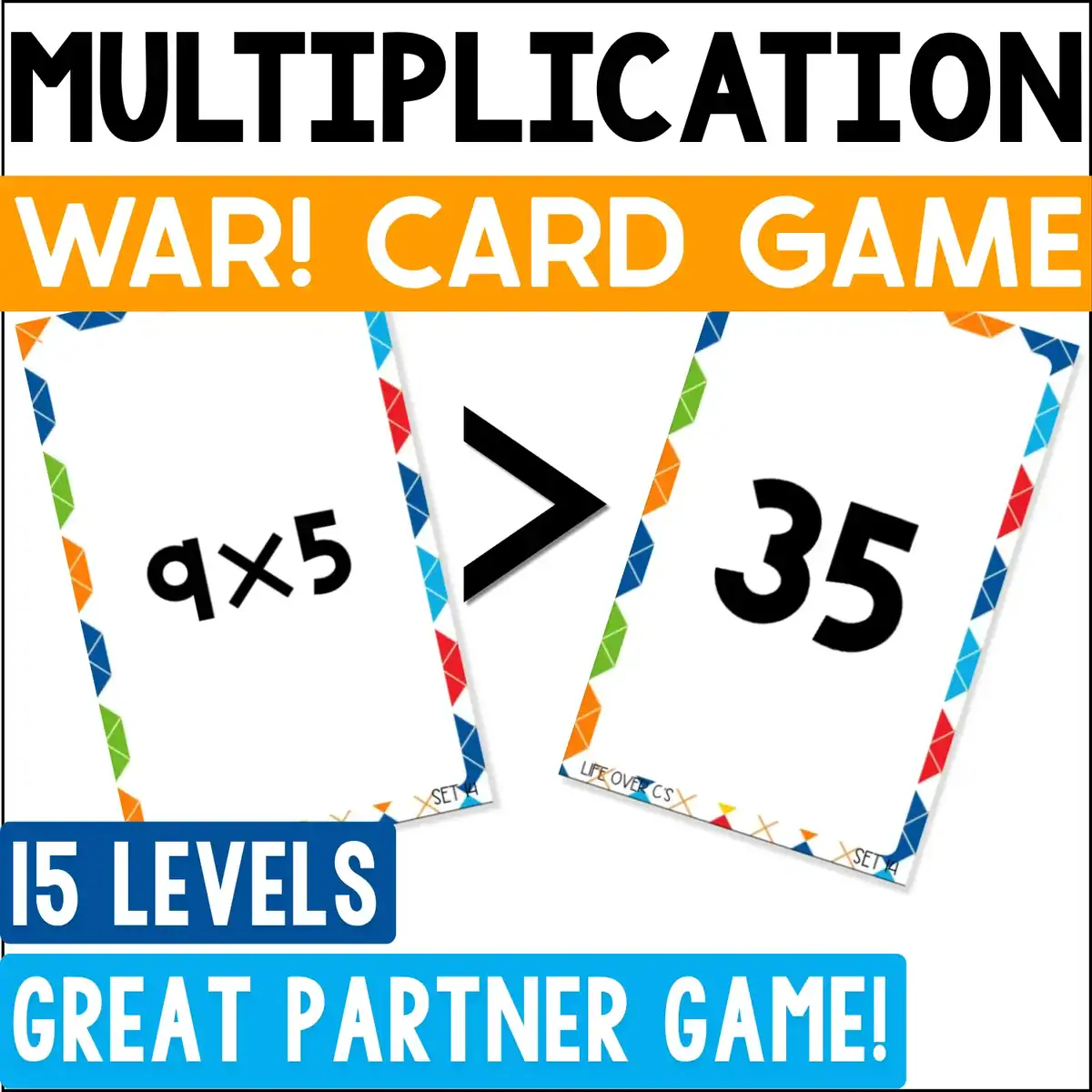
This multiplication version just adds a little twist: every card is a multiplication fact or product, so kids may have to solve a multiplication problem before they know who won the round.
Whether you’re just starting multiplication or reviewing facts before a big test, this multiplication card game builds fact fluency fast. It works for partners at a math center, early finishers, small groups or a quick game at the kitchen table after dinner. (Loser does the dishes? I’m just saying…)
Recommended Grade Level:
Materials for the Multiplication War Card Games Set
- Card stock or paper
- Scrapbook paper (optional)
- Laminating supplies
- Paper cutter or scissors
- Small plastic containers or envelopes for storage

What’s Included in the Multiplication War Card Games
This set of multiplication war cards has 15 different decks, so you can match the game to exactly where your kids are.
- 12 fact family decks (Sets 1 to 12): one deck for each fact family from 1 to 12. Each deck has the multiplication facts (like 6 x 1 through 6 x 12) plus their products, so kids compare facts to facts, facts to numbers and numbers to numbers. Working on the 6s? Grab Set 6.
- Square numbers deck (Set 13): 1 x 1 through 12 x 12, plus their products.
- 2 mixed review decks (Sets 14 and 15): facts from different fact families shuffled together for more challenging practice.
- Deck labels and instruction cards: label a container for each deck and keep the rules right with the cards.
Not working on multiplying 11s and 12s yet? Just pull those cards out. It doesn’t change how the card game works at all.
Materials and Prep
Prep is quick, and once your multiplication war cards are made, they’ll last you for years.
- Card stock or paper
- Scrapbook paper (optional)
- Laminating supplies
- Paper cutter or scissors
- Small plastic containers or envelopes for storage
To prep: Print two copies of each deck you want to use. The decks are color coded, so they’re easy to keep straight.
Want more review? Print more copies!
Card stock or laminating will help the cards hold up to lots of enthusiastic flipping. (And trust me, there will be some serious competition.)
Cut the playing cards apart and store each deck in its own labeled container or envelope so the 4s don’t end up mixed in with the 9s.
Teacher tip: Print the Multiplication “War” cards on the white side of scrapbook paper. Kids can’t see through the cards, and every deck gets a fun, colorful back.

Multiplication War Rules: How to Play
The rules for Multiplication “War” are the same as the classic “War” card game, so most kids pick it up in about 30 seconds.
- Shuffle the deck and split it evenly between two players.
- Each player keeps their cards face down in a stack.
- At the same time, both players flip over their top card.
- Solve any multiplication fact cards. The card with the greater value wins, and that player puts both cards at the bottom of their pile.
- Tie? That means WAR! Each player places three cards face down, then flips a fourth card. The highest value takes the whole pile.
- Keep playing until time is up or one player runs out of cards. The player with the most cards at the end wins!
Teacher Tip: I like to have kids say their multiplication fact out loud as they flip (“6 times 7 is 42!”). It slows the game down just enough to make sure everyone is actually solving and not just guessing which card looks bigger.
Why Multiplication War Builds Fact Fluency
It looks like just a card game (shh, don’t tell them), but there’s some serious multiplication practice happening every time those cards flip.
- Fast recall: Kids see the same multiplication facts over and over, and they want to solve them quickly to win the round. That repetition is exactly what builds automatic recall.
- Comparing numbers: Deciding whether 6 x 7 beats 40 sneaks in comparing practice and kids start to see how facts and products connect.
- Built-in checking: When players solve every fact card out loud, kids naturally check each other’s math. (Nobody lets a wrong answer slide when the cards are on the line!)
- Low pressure: A game feels a lot less scary than a timed test, so kids who freeze up on their times tables often relax and do better.
- Social skills: Taking turns, following rules and winning (or losing) gracefully all come along for the ride.
Once kids know their facts without counting on their fingers, bigger math, like division, fractions and multi-digit multiplication, gets so much easier.

Differentiate the Multiplication War Game
With 15 decks of multiplication war cards to choose from, it’s easy to meet every kid right where they are. Here are a few more ways to adjust the game.
Simplify
- Start with the easiest fact families (1s, 2s, 5s and 10s) before moving on.
- Keep a multiplication chart on the table so kids can check their answers.
- Give each player a handful of counters or a whiteboard to draw arrays and work out tricky facts.
- Play cooperatively first: flip together and solve each fact as a team before playing to win.
On-Level
- Use the multiplication fact family deck that matches what you’re working on in math time this week.
- Have kids say the full multiplication fact out loud every time they flip.
- Ask the winner of each round to explain how they know their card is worth more.
Add a Challenge
- Switch to Set 13 (square numbers) or the mixed review decks in Sets 14 and 15.
- Play with a one-minute timer and count how many rounds you can finish.
- Flip two cards each and add their values together. The highest total wins.
- Have kids write a matching division fact for every card they win.

More Multiplication War Games to Try
Once your crew has the basic Multiplication “War” game down, mix things up with one of these.
- Three-player War: Divide the deck three ways. The highest value takes all three cards.
- Lowest wins: Flip the rules so the smallest value takes the round. It’s surprisingly hard to switch your brain!
- Speed round: The first player to call out the value of both cards wins the pile.
- Match it up: Lay one deck face up and match each multiplication fact card to its product card. Then, race to put the pairs in order from smallest to largest.
- Take it home: Send a deck home for family game night. Parents love an easy way to help with times tables practice at home. (And the kids love beating their parents.)
Frequently Asked Questions
What grade is the Multiplication War card game for?
Multiplication “War” is a great fit for 2nd through 5th grade. Younger kids can start with the 1s, 2s, 5s and 10s, while older kids can use the mixed decks for review.
Can I play Multiplication War with a regular deck of cards?
Yes! It’s one of the easiest multiplication games to play with a deck of cards. Remove the face cards (or let jacks, queens and kings equal 11, 12 and 13). Each player flips two cards and multiplies them. The highest product wins. The printable decks make it easier to focus on one fact family at a time, though.
Can I use the cards as multiplication flash cards?
Yes! Each deck has the fact cards and their product cards, so kids can flip a fact, solve it, then find the matching product card. It makes a great warm-up before a round of Multiplication “War.”
How many players can play?
This card game is designed for 2 to 4 players. Just divide the deck evenly and the highest value takes all the cards in that round.
What happens if both cards have the same value?
That’s WAR! Each player places three cards face down, then flips a fourth card. The highest value wins the whole pile.
How long does a game of Multiplication “War” take?
A full game can go on for a while, so I usually set a timer for 10 to 15 minutes. Whoever has the most cards when it goes off wins.
How can parents use this at home?
Play a few rounds of Multiplication “War” after dinner or on the weekend. It’s a quick, low-pressure way to practice facts. Most kids don’t even realize they’re studying!
Do you love this activity?
Pin it for later!
Get the Multiplication War Card Games
Ready to hear “One more round, PLEASE!” during math time? Grab all 15 decks of the Multiplication War card games and get your kids flipping, solving and (friendly) battling their way to multiplication fact fluency.
Thanks for being awesome!
-Kim
More Math War Card Games
If your kids love this one, keep the battles going with these:
- Division War
- Decimal Place Value War
- Large Number Place Value War
- Fraction War
- Upper Elementary Math War Bundle
Multiplication Activities You’ll Love:


Search All Activities
Looking for more? Find exactly what you need here:


